
Quantum Technologist · Strasbourg

Shannon Whitlock

I build quantum systems that control individual atoms with laser light; making neutral-atom quantum computing practical, scalable, and useful in the real world.

or email me directly:

Fig. 01 Loading of an 8 × 5 optical tweezer array — each dot represents a single atom held by a focused laser.
01

About

For more than twenty years, I have built experimental systems that manipulate individual atoms with laser light. My mission is to build the first practical neutral-atom quantum computer.

My work spans research, training, and innovation. I coordinate aQCess, France’s first public platform for neutral-atom quantum computing, and co-founded QPerfect to develop software for emulating quantum systems and compiling algorithms for neutral-atom hardware. Recently I co-authored a major review on Rydberg quantum computing and developed AtomTwin.jl, the first electronic-design-automation framework for neutral-atom quantum hardware.

At the European Center for Quantum Sciences (CESQ), I lead a group of 14 researchers and project managers across three teams spanning fundamental research, quantum engineering, and European-scale training initiatives for the next generation of quantum scientists and engineers. I have graduated seven PhD students from my lab and currently (co-)supervise six more together with two CIFRE industrial doctorates.

Portrait of Shannon Whitlock
CESQ Quantum Week 2025

Funding & awards

  • Helping coordinate large-scale European initiatives in quantum technologies, including aQCess, DigiQ, MLQ, and the European Quantum Academy (~€50M active portfolio).
  • PI or coordinator on seven active grants supporting quantum computing research and infrastructure in Strasbourg (~€13M local share).
  • Personal grants and chairs: IUF Senior Chair (2022–2027), IdEx Chaire d’Excellence (2016–2019), USIAS Fellowship (2017–2020); Emmy Noether starting grant recipient (DFG, 2013–2017) and former Marie Skłodowska-Curie fellow.

Current positions

Past roles
  • 2016–2019 Initiative d’Excellence Junior Chair (€500k), University of Strasbourg / IPCMS
  • 2013–2017 Emmy Noether Group Leader, Heidelberg (DFG, €1.67M — equivalent to an ERC Starting Grant)
  • 2010–2012 Co-PI, University of Heidelberg (DFG individual project, €300k)
  • 2007–2010 Marie Curie Fellow, University of Amsterdam (MSCA IIF, €160k)
  • 2004–2007 PhD, Swinburne University of Technology, Australia

Areas of expertise

  • Quantum computing
  • Laser cooling & trapping
  • Experimental physics
  • Many-body physics
  • Rydberg atoms
  • Quantum emulation & benchmarking
  • Quantum software
  • Atom chips
  • Quantum sensing
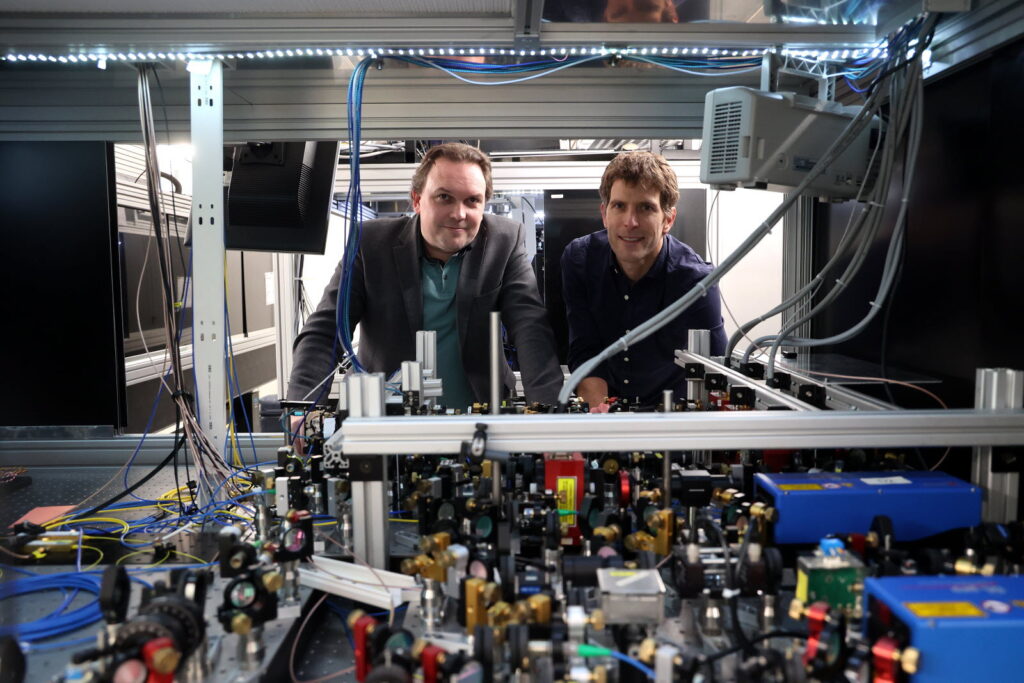
Shannon Whitlock and Tom Bienaimé in the EQM Lab
Photo: DNA — Les Dernières Nouvelles d’Alsace
02

Research

Major national and international projects led from the European Center for Quantum Sciences in Strasbourg.

Featured · Public platform

aQCess — Atomic Quantum Computing as a Service

France’s first open and public platform for digital quantum computing on high-quality atomic qubits.

2021–2029 €8.85M total €5.7M Unistra Coordinator

aQCess is powered by arrays of individual atoms trapped by optical tweezers, with interactions mediated by highly excited Rydberg states — one of the most competitive physical systems for scalable quantum computing. The platform hosts over 400 individually controlled ytterbium qubits for universal quantum computing, and is open to academic, industry, and educational partners.

What makes aQCess distinctive

  • Full-stack digital platform built around ytterbium-171 atoms — natures best qubits.
  • Dual-qubit architecture for robust qubit encoding, storage, processing, and readout.
  • Highly optimised universal gate set with native multiqubit gates and fast all-optical control and readout.
  • Open access for research, industry trials, and quantum workforce training across seven research institutes, five graduate programmes, and four international partners.

Use cases

Quantum chemistry · material discovery · fundamental physics · optimisation · machine learning.

Hosted at the European Center for Quantum Sciences (CESQ), Strasbourg. Supported by France’s Programme d’Investissements d’Avenir (ANR-21-ESRE-0032) and the Programme et Equipements Prioritaire de Recherche Quantique (PEPR), within the French national quantum strategy. Also part of the European EuRyQa infrastructure.
aqcess.cesq.fr → Read the technology review

Other major projects

03

Publications

Latest preprints

Pulled live from arXiv.

Loading latest preprints…

A complete and continuously updated list of papers, citations, and co-authors is maintained on Google Scholar.

Full list on Google Scholar → ORCID

04

Software

Open tools and frameworks for designing, simulating, and benchmarking neutral-atom quantum hardware.

Featured · Open source

AtomTwin.jl

An open-source design and simulation framework for neutral-atom quantum processors.

Think of it as a CAD environment for atomic quantum processors — letting hardware teams, control engineers, and algorithm designers work against a faithful, physics-grounded twin of the machine, before a single laser is turned on.

Under the hood, AtomTwin bridges the gap between abstract models and real devices: it simulates atoms, optical tweezers, laser fields, motion, interactions, and noise directly from physical geometry and parameters — without constructing Hamiltonians by hand. It ships with hardware-level instruction sequences, high-performance coupled quantum–classical solvers, and a ready-to-use ytterbium-171 qubit model in an extensible framework.

Who it’s for

  • Hardware & firmware developers working on instruction sets, pulse sequences, and control stacks.
  • Experimental atomic physicists who need fast, accurate simulation of neutral-atom and laser-driven systems.
  • QEC and compiler researchers wanting hardware-realistic noise and error models from atomic-level simulation.
  • Educators & students exploring atomic quantum hardware with approachable, research-grade tools.

Developed as an educational module within DigiQ, AtomTwin.jl provides a realistic model of the aQCess platform under construction in Strasbourg.

GitHub → Preprint (arXiv:2604.18531) Documentation

Other tools & specifications

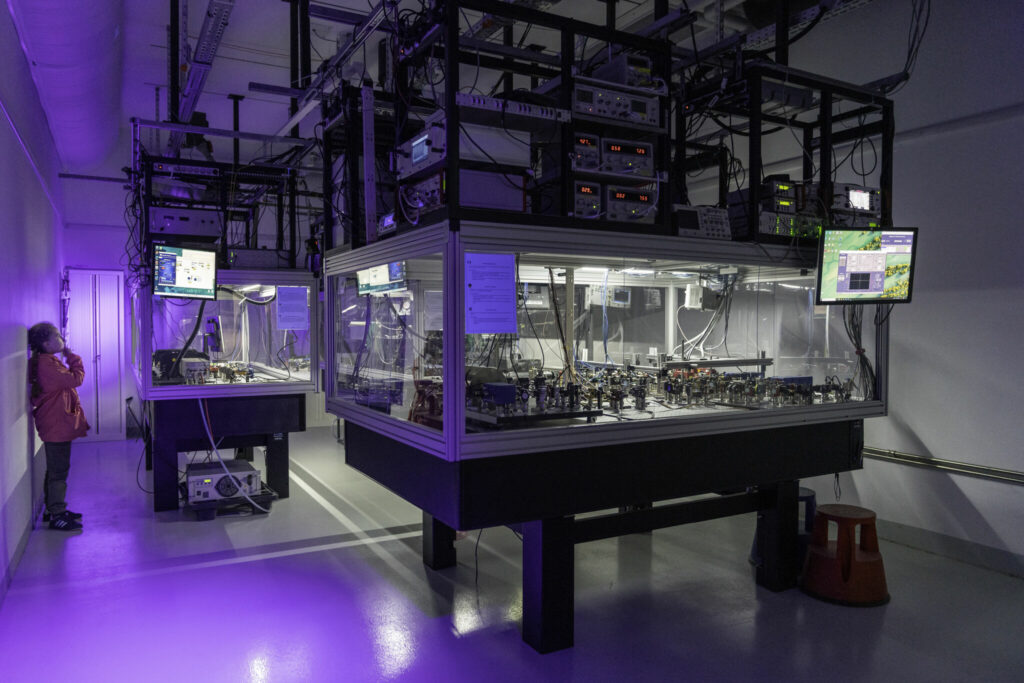
Quantum computing hardware in the laboratory
Photo: Corinne Longhi
05

Impact

Beyond the lab, my work touches science and society through industry ventures, scientific service, and peer recognition.

Featured · Industry venture

QPerfect

Neutral-atom quantum computing company developing software for fault-tolerant quantum computing and large-scale emulation.

I co-founded QPerfect in 2023 to bring research-grade quantum software into industrial use. As Co-founder and R&D Strategy lead, I help shape the technical roadmap and the bridge between academic research and product. The company’s flagship product, MIMIQ, has become one of the most powerful matrix-product-state quantum emulators in use across academia and industry.

QPerfect was acquired by BTQ Technologies in November 2025.

Two patents in quantum emulation and quantum gate protocols. See the Software section for the open-source tools and specifications developed alongside.

qperfect.io → MIMIQ on this site

Events organised

Service to science

  • Co-coordinator, European Master Certificate EFEQT. Lead the European-wide training programme for MSc students in quantum science and technology — over 200 students since 2021.
  • Reviewer for funding agencies: ERC, ESF, ANR, Sirteq, DFG, W. M. Keck Foundation, DOE.
  • Leadership across European programmes: aQCess, Gen-Q, MSCA MLQ, QMat, MSCA MOQS, QUSTEC.

Outreach & media

  • Co-author, EuRyQa White Paper (2025)The future of neutral-atom quantum computing in Europe, a strategic roadmap for large-scale fault-tolerant quantum computing on neutral-atom platforms.
  • Featured in DNA — Les Dernières Nouvelles d’Alsace on the computer of the future being constructed in Strasbourg.
  • Interview with SheQuantum (2020) on experimental quantum physics, diversity, and mentorship.
  • Regular invited and keynote talks at major national and international conferences.
06

Training

I lecture and coordinate in leading European doctoral and master’s programmes in quantum technologies. Students thrive when they feel part of the scientific community and are empowered to tackle real-world research challenges. My approach focuses on broadening horizons through international networking, hands-on experimentation, simulation-driven learning, collaborative teamwork, and opportunities for independent problem-solving.

07

Contact

Address

Shannon Whitlock
CESQ — ISIS, Bât. 120
23 rue du Loess
67034 Strasbourg, France